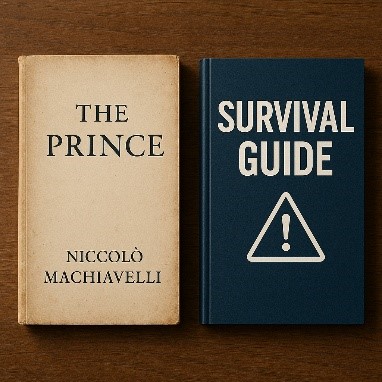
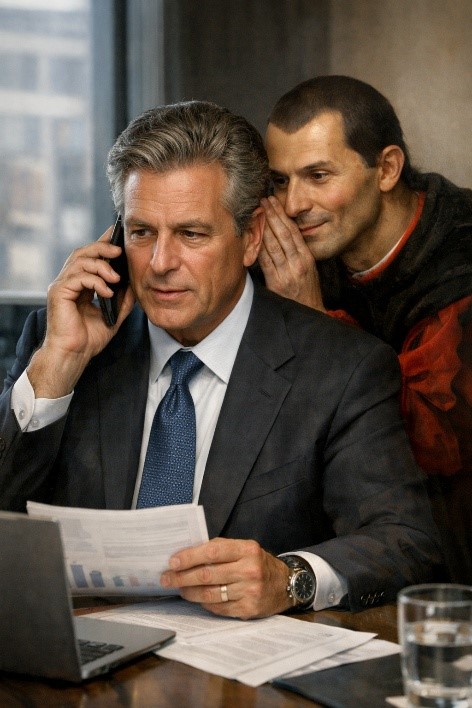
After a 16th-century portrait of Niccolò Machiavelli reimagined in a modern office setting,
You’ve landed your first job. The office smells like ambition and burnt coffee. You’re surrounded by smiles that don’t always reach the eyes. There are meetings where “collaboration” means: who gets the credit?
And your boss can charm the people department while quietly making everyone dance to his tune. Welcome to modern work. And say hello to Niccolò Machiavelli from around 1500.
If you give any thought to Machiavelli, you probably see him as some scheming Renaissance villain whispering into a prince’s ear: “stab your rivals”.
Sound familiar? Of course, because today’s boardrooms are his Florentine courts but with better lighting.
Look closely and you’ll spot the Mach’s influence everywhere: in office politics, the “strategic alliances,” and the boss who smiles through clenched teeth as he—it’’s usally a ‘he’, while dissecting, restructuring or shutting down your team.
The Mach was indeed a cunning political observer. He saw humans not as we ought to be, but as we actually are.
His 500-year-old manual on ambition and survival for top bosses wasn’t about cruelty for its own sake; it was about maintaining power in systems driven by ego, fear, and ambition. So what’s new? Not much.
Right now I’m going to decode a few of his principles. I’ll show you how they’re already busy at work on you, whatever your job.
First up , is the Mach’s contraversial view that:
1. “It is better to be feared than loved, if you cannot be both.”
No, your boss isn’t necessarily plotting an empire, but knows that boundaries matter. The boss who tries too hard to be liked gets eaten alive. The one who mixes charm with a hint of danger? That’s Machiavellian gold.
You respect such bosses and maybe fear disappointing them, and that alone keeps you on their side.
Then and now, fear doesn’t mean terror. It means control.
2. “The ends justify the means.”
Every big corporate change presentation hides this nasty claim behind the PowerPoint slides.
Layoffs are presented as “efficiency.” Greenwashing promises “brand alignment.” Media managers post “authentic” content that has been pre-approved by five layers of public relations and drained of meaning.
This isn’t cynicism — it’s strategy. Machiavelli would shrug and say, “If it works, it works.”
Another Mach view which was astute then, and still brilliant now, though not the “men” bit.
3. “Men judge generally more by the eye than by the hand.”
Today that translates as: for most people, optics rule. Meaning? Well in Machiavelli’s time, princes staged grand parades; today, CEOs post photos of themselves in fashion gear, pretending to be “one of the team.”
Then and now image outpaced substance. The trick? Don’t be fooled by the theatre, learn from it. Presentation isn’t evil; it’s armour.
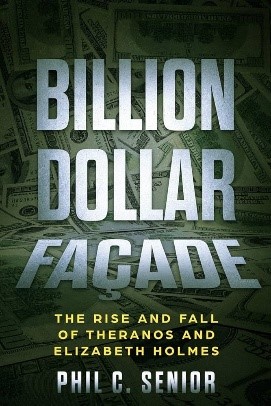
For a while at least the optics worked for Elizabeth Holmes, founder of Theranos.
She built a $9 billion biotech company based on a myth.
Here she is in her turtleneck just like Steve Jobs. Liz spoke in a calm, serious voice, and promised to revolutionise blood testing.
Investors, politicians, and journalists believed her. Not because the technology worked (it didn’t), but because she looked like the next Silicon Valley visionary.
Then and now nvestors and citizens judged the image, not the evidence.
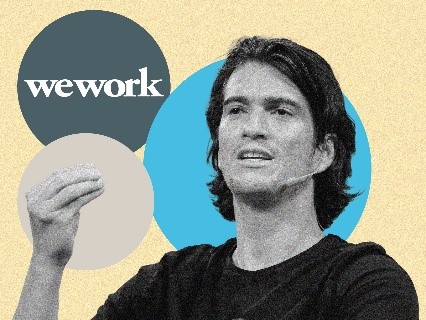
More optics. The founder of WeWork, Adam Neumann, sold the idea that his co-working company was a global movement to “elevate consciousness.”
Investors adored his swagger and barefoot boardroom vibe.
For years, no one noticed the business was financially hollow. He raised billions and crashed spectacularly, proof that performance mattered less than charisma.
He embodied the rule: style first, numbers later.
Here’s another smart Mach observation that’s lasted through the ages:
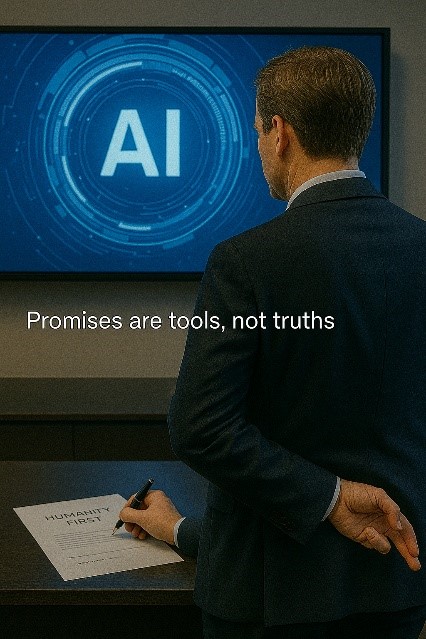
4. “A prince never lacks legitimate reasons to break his promise.”
Watch how corporate commitments shift. Remember how ChatGPT was initially presented as not-for-profit and for the benefit of humankind?
Promises are tools, not commandments. That sounds bleak, but for you, it’s a warning and a lesson:
Always document, always clarify, and never mistake strategy for sincerity.
5. The Machiavellian Employee
Here’s the twist: Machiavelli’s not just in the corner office. He’s right inside you when you learn to read power without losing integrity.
It’s not about becoming ruthless, it’s about becoming realistic. Know when to speak, when to stay silent, and when to strike (politely).
Awareness of power is the first step to navigating it. This is classic “realism without ruthlessness.”
So next time your boss announces a “bold new direction,” smile knowingly. Machiavelli’s in the room, running the meeting, writing the memo, and maybe if you’re smart, whispering in your ear too.
This blog is from a series on the modern Machiavelli. Watch out for more on the Mach. Sign up for more about some of history’s most interesting characters visit: andrewsbooks.site/blog.