


1763–1809
The streets of Jena, Germany, in November 1798, are slick with rain. A fine mist clings to the Leutra stream as it winds through the town, and lamplight blurs against the fog.
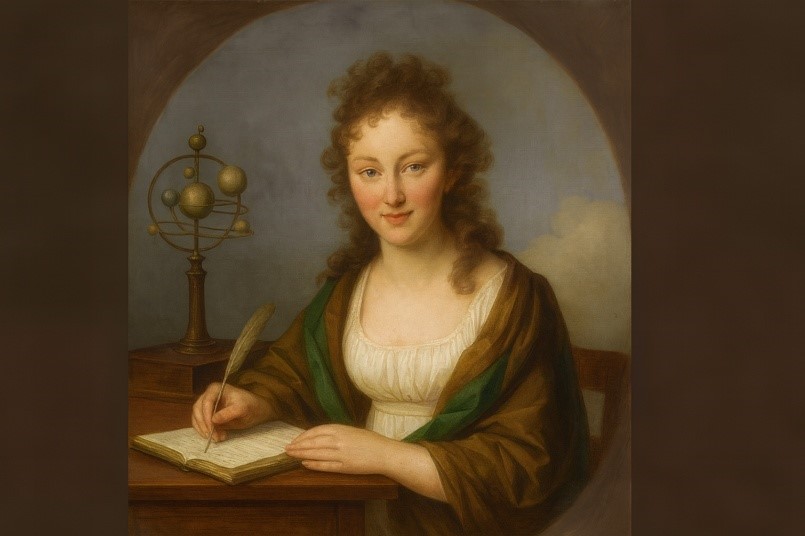
Caroline Schlegel lives at the centre of early German Romanticism, a precious time of freedom of expression and free thinking.
This small, vibrant town has an enviable reputation for innovative ideas that are having an impact across Europe. Inside the Döderlein house on Leutragasse, warmth glows from the upper windows. This is the Schlegel home, part salon, part sanctuary, part battlefield of ideas.
Caroline sits near the fire, her pen poised above a letter to her friend Therese Forster. A pot of coffee cools beside her; the smell of ink, wax, and damp paper fills the room.
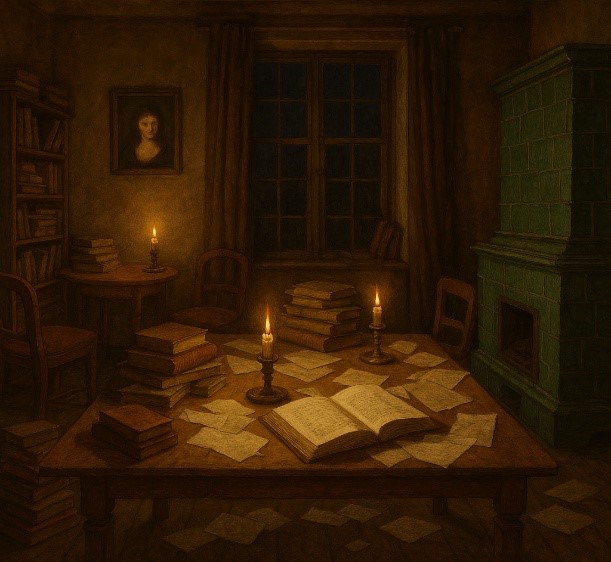
Books lie open on every surface — Goethe’s Wilhelm Meister, a manuscript of Schelling’s lectures, fragments of a translation from Shakespeare that she has annotated in the margins with tiny, precise handwriting.
Outside, a cart rattles over the cobblestones. She glances up, half expecting Schelling’s quick, urgent knock, or perhaps the poet Novalis, bringing one of his gentle, unworldly speculations about spirit and nature.
But tonight, the house is quiet. The firelight catches the carved spines of books, her lace cuffs, and the little silver scissors she uses to cut paper for sealing her letters.
As if to shake off a thought, Caroline stretches. She is thirty-five, brilliant, restless, and alive with a kind of contained electricity — a woman too intelligent to play merely hostess, too self-aware to ignore the limits placed upon her.
As I enter, she studies me with open amusement, one eyebrow lifted. It’s the same expression she uses when Schelling starts one of his involved sentences with: ‘Nature is the visible mind of God.’
“Well, then. Another visitor.” Caroline smiles. “Would you like coffee or conversation? I warn you, I’m short of sugar but long on opinions.”
Caroline Michaelis, as she was born, is permanently busy translating, editing, writing critiques, and offering provocative challenges to the status quo.
Triple married at different times to intellectuals Böhmer, Schlegel, and Schelling, Caroline refuses to be defined by any one of them. What matters is her quick mind and the way she shapes the ideas flowing through Jena.
She has invited me to step into her Jena parlour, located in the apartment on Leutragasse Street in this highly cultured university town.
Jena at this time buzzes with a new way of thinking called Romanticism, a movement that values imagination and feeling over rigid rules.
Her much-inhabited room, books huddle in piles, and pages with wet ink lie scattered across the table. Candles gutter in their holders, and a green tiled stove pushes against the cold.
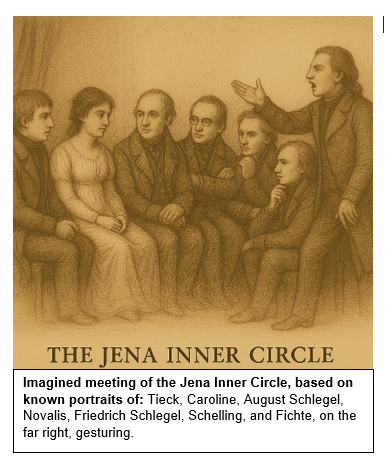
The renowned poet and playwright Goethe has sat here; the Schlegel brothers, literary critics and philosophers, have argued here; philosopher Fichte, another famed philosopher, has thundered about freedom; and Novalis, the pen name of a German aristocrat, poet and polymath, has dreamed aloud of blue flowers.
This room is special and not a parlour for polite chatter. It is a workshop for ideas that are transforming how Europe perceives art and the self. Caroline sits at the extended table, alert and focused. When filled with visitors, her laughter cuts through pomposity, her judgment trims excess.
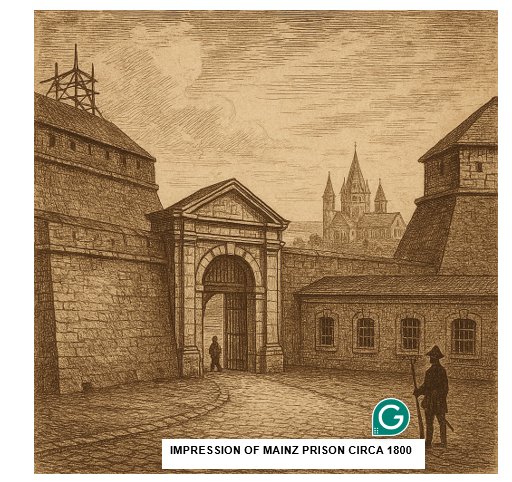
Caroline has known prison in Mainz and the grief of losing her daughter, Auguste and other children. Yet, she carries these scars with a steadiness that quiets the room.
She is not mystical, like the poet Novalis, nor is she noisy, like the philosopher Fichte. She seems ready for a conversation, so I take a deep breath and begin:
Frau Caroline, you spend hours editing the magazine Athenaeum, refining, cleaning your husband’s Shakespeare translations, and sharpening Friedrich Fichte’s thought-provoking random Fragments.
Despite this, your name seldom surfaces, doesn’t that sting?
A ghost of a smile appears on her face: “It is true. Laughter removes some of the bitterness when I read the pages and see my sentences walking around in borrowed clothes. I admit there’s also a distaste which doesn’t vanish.
Instead, it sits in memory, ripening into judgment. Yet such judgment is mine to keep, even when the credit is lost.”
You carry such disappointment so quietly. That must take great strength.
“It isn’t hard, it is simply clear. I know what I wrote, what I strengthened. That knowledge steadies me more than public praise could.”
Then tell me, you who preside over such wide-ranging conversations, what is Romanticism, in this town and at this very table?
“What is it? That’s a fair question. Romanticism is permission. It is freedom to let fragments go unfinished; it welcomes contradictions to coax forth the truth, just as you would tempt a shy animal.
We believe that jokes can be serious, and feelings can be intelligent. That is rebellion enough. Around this table, seriousness and laughter live together.”
That sounds like a conspiracy.
“A domestic conspiracy,” she laughs. “We plot against boredom, against the lifeless style of officials. And when the men grow too solemn, I prick them with a needle of sense. They need reminding not to drown in their own profundity.”
So editing becomes a kind of needle?
“Exactly. Editing is like keeping a house in order. You open windows, clear tables, and tell a sentence it isn’t fit to step outside.
Sometimes an entire passage needs a good bath before it can be seen in public. The work may sound practical, but practicality merely saves us from drowning in brilliance. Pages need clear air more than decoration.”
That plainness is striking; it keeps Romanticism from floating away into abstraction.
“Yes, imagination must breathe, or it becomes suffocating.”
You speak as if clarity is also a kind of discipline. Did your time in Mainz sharpen that sense?
Her face freezes. “Cold walls strip everything away. Liberty without intelligence is drunken noise. Intelligence without liberty is a locked cabinet. I learned to want both together.
And once you’ve eaten prison bread, you waste nothing—not thought, not time, not freedom.”
That sounds less like bitterness than sharpening.
“That’s the point. Hardship did not harden me; it honed me. Constraint can polish as much as it wounds.” Her hands fold on the table; her gaze fixes on the grain of the wood:
“There are wounds no discipline can touch. A bright child is gone.” She pauses to look down as if forced to re-live the horror of her daughter Auguste’s death.
“She died unjustly to the world and irreversibly to me. My husband, Schelling, loved her and tried to save her. The gossip feasted on our grief. Philosophy cannot return a child. After her death, the Jena circle still joked and wrote, but a quiet river ran beneath everything.” Her eyes lift at last: “That river never dries.”
That must have changed your closeness with Schelling as well.
Her eyes brighten. “With Schelling, I share a hunger to test thought against life. His philosophy breathes. It wants sap, not statues. After Auguste’s death, I find it impossible to love statues. I need what is alive.”
And your earlier marriages? How do you see them now?
“Böhmer left me a widow too soon. Schlegel gave me work and quarrels in equal measure. Schelling is not my husband, but his thought walks close beside me. I take what each season gives and prefer to stand in my own name.”
Tell me about evenings in this room.
“Ah! The evenings. How can I make you see them?
Friedrich drops an aphorism like a pin and grins as we tread on it.
Ludwig Tieck—ever the spinner of stories, half-playwright, half-magician—bursts in with tales spilling from his pockets.
Novalis drifts through like a lantern on a string.
And Goethe—he brings the weather with him. When he leaves, we check the sky to see if it has changed.”
And your role among them?
“I keep the barometer honest. I cut through their storms with judgment and laughter.”
If you could speak directly to writers who come after you, what would you tell them?
“Use permission as a tool, not a trophy. Never trust solemnity, including your own. Irony can guard against vanity, but love must share the work.”
If I handed you my manuscript of this conversation, where would you begin?
She chuckles: “At the verbs. Weak verbs make a sentence stumble before it begins. Courage starts with verbs that stand on their feet. Plain nouns, fewer adverbs, words that hold their own weight, that is, courage on the page.”
You would have a field day with mine.
“Good. You would learn fast.”
Since we’re talking about writers, what so many of them fear most is being forgotten. Is that how you feel?
“Being forgotten is nothing. What I fear is being misread, turned into something I am not. But that is the risk of being read at all.”
She politely indicates that we are finished, and I step into the corridor as the stove ticks and the street outside darkens.
In our conversation, she has not confessed nor defended. She has shown what it means to keep a room honest. In her company, Romanticism is not a slogan but a way of working: fragments left alive, irony kept in check, judgment sharpened.
What lingers with me is not her grief or scandal but her refusal to be ornamental, or to be confined to irrelevance. Instead, she makes a workshop of every parlour and insists that the air stays fresh.
PERSPECTIVE
Despite her self-effacement, Caroline Michaelis, later Caroline Böhmer-Schlegel-Schelling, was a central figure in Romanticism. However, history has long tried to confine her to the margins.
Yet she edited, translated, reviewed, and, what mattered most, she kept the Romantics honest. With an unrivalled knack for spotting contradictions, she reminded them to be less solemn.
In the heady atmosphere of Jena, where grand theories and poetic systems floated in the air, Caroline brought wit, irony, and the sharp edge of lived experience. She grounded the conversation, refused pretension, and gave Romanticism a voice that was as incisive as it was humane.
Her legacy is her judgment, her fearless laughter, and her insistence that women belong at the table where ideas are made—never confined to the names of husbands but remembered in her own right.
©

2025
Published at www.andrewsbooks.site
References that helped anchor the imaginary conversation.
- Caroline’s Letters / Correspondence Editions
- Caroline: Letters from Early Romanticism — the principal edition of her correspondence, often based on Erich Schmidt’s 1913 edition. carolineschelling.com+1
- The DFG project Correspondences of Early Romanticism — a scholarly digital archive of the Jena circle’s letters (Schlegel, Caroline, Novalis, Tieck, etc.). Johannes Gutenberg University Mainz
- Historical/biographical monographs
- The website Caroline Schelling — Biography (project site) lists classic biographical essays and memoirs (e.g. Luise Wiedemann’s memoir, Waitz’s edition) and gives a sense of the textual foundation. carolineschelling.com
- Caroline Schelling entries in Fembio and in the History of Women Philosophers project give solid, concise biographical overviews. Fembio+1
- Sabine Appel, Caroline Schlegel-Schelling: Das Wagnis der Freiheit (2013) — one of the more recent serious biographies (in German). (Listed in her Wikipedia “Literature” references.) Wikipedia
- Specific evidence supporting elements in the conversation
- The letter from Caroline Böhmer, April 19, 1793, while imprisoned in Königstein, to Louise and Friedrich Wilhelm Gotter, where she mentions her pregnancy, her fears, the political context, etc. German History in Documents and Images
- The American Scholar article “Jena-Gadda-Da-Vida” recounts that Auguste died of dysentery in 1800, and mentions that critics (including the translator Tieck) dismissed parts of the Leutragasse circle as a “farm full of pigs.” The American Scholar
- Women of Letters: A Study of Self and Genre in the Personal Writing of Caroline Schlegel-Schelling, Rahel Levin Varnhagen and Bettina von Arnim (by Margaretmary Daley), which analyses Caroline’s letters as literary art, and shows how her correspondence supports the imagining of her interior voice. Academia+2JSTOR+2
The German and English biographical dictionaries (e.g. Britannica) that note her marriages, her role in the Romantic circle, her influence and controversies with Fichte, etc. Encyclopedia Britannica
©
2025